This morning, the Guardian has a summary of Edward Snowden’s online chat comments yesterday, as well as an overview of the number of government data requests various Internet service providers have been receiving—Yahoo reports c. 2,000/month; Apple, c. 750; Facebook, c. 1,500; Microsoft, c. 1,000. They were unable legally to break out how many of those were Foreign Intelligence Surveillance Act (FISA) requests as opposed to the more numerous requests related to criminal investigations.
Timely topics
Ed Snowden Q&A online this morning.
In an unprecedented bow to citizen journalism, for about an hour and a half this morning, Edward Snowden answered 18 questions submitted online. The questions and answers are republished in full at http://www.guardian.co.uk/world/2013/jun/17/edward-snowden-nsa-files-whistleblower?commentpage=6
While he did not get to my specific questions, Snowden provided useful clarification about the difference between policy restrictions and technical capabilities for accessing communication content.
While he made it clear that he was divulging information only to journalists, not governments, the mainstream media did not fare well:
Initially I was very encouraged. Unfortunately, the mainstream media now seems far more interested in what I said when I was 17 or what my girlfriend looks like rather than, say, the largest program of suspicionless surveillance in human history.
I loved his witty response to the question of whether he was supplying China with information in exchange for asylum:
Ask yourself: if I were a Chinese spy, why wouldn’t I have flown directly into Beijing? I could be living in a palace petting a phoenix by now.
NSA/PRISM/Snowden news roundup
The Guardian has published a helpful “Online privacy and PRISM news and teaching resources round up.” It includes many of the Guardian articles I’ve been linking, plus teaching materials (anyone have Dick Cheney’s email?) and a lot more.
Snowden’s latest revelations in the Guardian make me reevaluate my recent quip about the Brits not wanting to get involved. Snowden disclosed that during the 2009 G20 summit in London, British agents were monitoring the computers and intercepting the phone calls of foreign officials and even set up an internet café so they could read their email. This is getting to look more and more like an episode of MI5, the BBC high-tech spy series that kept public TV viewers on the edge of their seats for several years. Snowden’s and the Guardian‘s timing is pretty good; the Brits are hosting a G8 summit Monday.
An Observer/Opinium poll of 1,942 Brits was released yesterday:

Escape
I just got an email from go-today, the outfit that arranged our last trip to France.
At the head of the list for today’s bargain “affordable and attractive packages”:

Hong Kong Escape!
Has someone been reading my blog?!
Updates: Desert daze
I’ve added some new material to the “Desert daze” archives and more clearly labeled the articles and magazine in which they were published.
 I’ve added a profile I wrote for Psychic magazine of Paul Crockett, the prospector who encountered members of Charlie Manson’s family in early 1969 staying at the Barker Ranch in the mountains above Death Valley. Crockett developed a close relationship with several dissatisfied members of the family. That summer, two of them, Brooks Poston and Paul Watkins, worked with Crockett, high-grading and hauling gold ore down to the ranch from mines in Goler Canyon in the Panamint Mountains, while Crockett helped them break from Manson and the family. It’s a story about the power of agreement, the working title of a more in-depth story based on a series of interviews with Crockett, Poston and Watkins in the early 1970s.

I’ve also added a slide-show of Death Valley, Spring 2010, with special attention to the wildflowers.
The Brandon Mayfield Case
You don’t have to have done something wrong; you simply have to eventually fall under suspicion from somebody, even by a wrong call. Then they can use the system to go back in time and scrutinize every decision you’ve ever made, every friend you’ve ever discussed something with, and attack you on that basis, to sort of derive suspicion from an innocent life and paint anyone into the context of a wrongdoer. —Edward Snowden

Lest you doubt Edward Snowden’s explanation of how the NSA’s dragnet might ensnare the innocent, Gail Collins’ column in today’s New York Times, “The Other Side of the Story” cites the Kafkaesque example of Brandon Mayfield of Portland, WA:
Based on a database mismatch of a suspicious fingerprint on a plastic bag tied to the Madrid bombing in Spain, where Mayfield had never set foot, agents obtained a secret warrant, broke into and searched his home. His 12-year-old daughter was terrified; she noticed someone had been in her room and had messed with her computer. The family became paranoid—for good reason. FBI agents walked into Mayfield’s office one day, handcuffed and took him away. He spent weeks in jail, imagining the worst. Spanish authorities, doubtful of the US fingerprint match, found the culprit who was the real match, and Mayfield was released.
What could possibly be more compelling than the fact that no one in the family had been to Spain? Well, the sophisticated government database that mismatched his fingerprint, correctly showed that Mayfield, who grew up in Kansas, after graduating from college, law school and serving in the Army, married an Egyptian immigrant and converted to Islam. He eventually got a rare FBI apology and $2 million for his trouble. “But you never quite get over these things,” Mayfield said. “It was a harrowing ordeal. It was terrifying.”
For more on the Brandon Mayfield case:
http://en.wikipedia.org/wiki/Brandon_Mayfield
http://www.justicedenied.org/issue/issue_25/brandon_mayfield.html
NSA/Snowden links:
Here are a couple links to more info:
…a New York Times piece about Ed Snowden’s daring adventures in Hong Kong and what we might call the Chinese gambit:
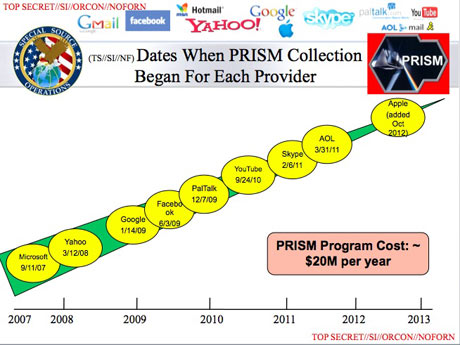
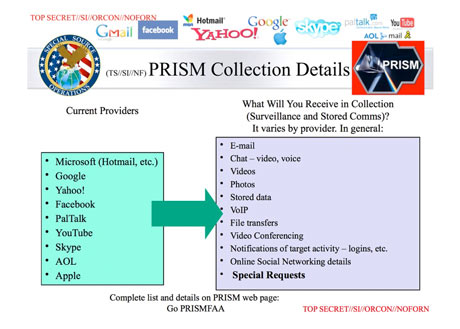
…and the week-old Guardian story detailing the NSA PRISM program, which goes much further than the metadata surveillance described in Snowden’s first revelations. NSA began directly accessing Microsoft servers in 2007 and has expanded the program to include all of the major Internet service providers—Yahoo, Google, Facebook, YouTube, Skype, Apple and probably whatever servers this connection we’re sharing right now is going through:
http://www.guardian.co.uk/world/2013/jun/06/us-tech-giants-nsa-data#start-of-comments
Confused?
The Guradian yesterday released a survey by Public Policy Polling which indicates that Ameircans may be more concerned about the National Security Agencies digital dragnet than polling results reported earlier suggest. PPP polls are generally reliable and target voters, which may explain some of the variations in attitudes. Of course different questions were being answered, too.
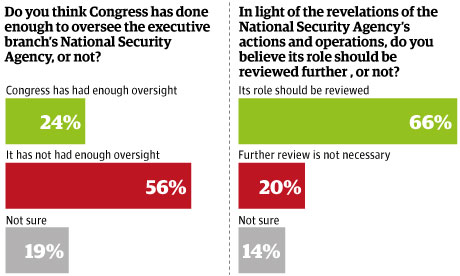
Two-thirds of the voters surveyed want NSA surveillance activities reviewed; 56 percent want greater congressional oversight. Sixty percent want the government to open up about its data collection programs to understand what’s going on; 61 percent welcome fresh debate about the balance between security and privacy.
PPP also found a major (58%) concern about the role of private contractors’ access to state secrets. Voters are pretty evenly split on whether they approve of the government’s collection of their personal phone and internet data.
Clearly, Mr. Snowden has stirred the pot. The Guardian reported:
The poll suggests that his stated ambition has, at least for now, been achieved: some 90% of those surveyed said they had heard about the recent news involving the NSA’s collecting and storing of Verizon phone records and gaining access to data from major internet companies…
Other reports, in the Guardian and elsewhere, show Snowden playing a skillful yet very dangerous game. Some have questioned his choice of Hong Kong to make his stand. He seems to have the US government in a Catch 22: If he is charged and extradited, Hong Kong police must arrest him, seize his files and computers; and hand them over to the Chinese government, which the US may want to avoid.
If the Brits were to get involved, it would make one heck of an MI5 episode! But it looks like the Brits do definitely not want to be involved. The Home Office has alerted the world’s airlines that Mr. Snowden is persona non grata; dropping him on British soil will cost—£2,000 + cost of housing and/or disposing of Snowden. The Brits don’t want to become entangled in another secret documents leak scandal. Last year, facing extradition to Sweden WikiLeaks founder Julian Assange was granted political asylum at the Ecuadorian embassy in London,
in the minority again
I should not have been surprised yesterday, when CBS released a poll showing that 59 percent of Americans think the government has struck the right balance between fighting terrorism and protecting civil liberties or that the government has not gone far enough, while only 36 percent say the NSA has overreached.
 The Pew Research Center & Washington Post just released a poll showing similar attitudes:

Public opinion hasn’t changed much in the seven years since USA Today reported that the government:
has been secretly collecting the phone call records of tens of millions of Americans, using data provided by AT&T, Verizon and BellSouth,” attributing that information to “people with direct knowledge of the arrangement.
The NSA program reaches into homes and businesses across the nation by amassing information about the calls of ordinary Americans — most of whom aren’t suspected of any crime. This program does not involve the NSA listening to or recording conversations. But the spy agency is using the data to analyze calling patterns in an effort to detect terrorist activity, sources said in separate interviews.
Two days later, on May 7, 2006, the Washington Post reported that the NSA practice was acceptable to 63 percent of those polled and unacceptable to 35 percent.
Gee, I’m in the minority—again. I kinda feel like I did when I quit paying the 10 percent federal excise tax on my phone in 1968. The tax was thought to be supporting the war in Vietnam. Along with turning in my draft card at an anti-war rally, it was a feeble protest. The IRS attached my bank account and recovered the tax. I closed the bank account, bought and converted a school bus, boarded my family, some friends and disappeared from the system until reemerging some years later…. But that’s another story.
The right of the people
The right of the people to be secure in their persons, houses, papers, and effects, against unreasonable searches and seizures, shall not be violated, and no Warrants shall issue, but upon probable cause, supported by Oath or affirmation, and particularly describing the place to be searched, and the persons or things to be seized.
If these words no longer apply, we should go through the process of amending them. In an opinion piece published in the Guardian and on his blog, Dan Ellsberg describes the NSA operations Ed Snowden disclosed as an “executive coup” against the US constitution.
A disciplined minority of totalitarians can use the instruments of democratic government to undermine democracy itself. —Hannah Arendt
 Richardson's rummage
You must be logged in to post a comment.