Tribute to a veteran: Robert Earl Richardson

Bob

From Robert Earl Richardson’s June 30, 1987 obit in the Detroit Tribune:

   A three-page US Navy public relations report of the [sniper] incident written when Richardson returned to Royal Oak on convalescent leave reported that the then-father of one [yours truly] was wounded while treating a Marine.
   “The little Marine came running up with his Tommy gun. Suddenly he threw his arms up in the air and fell to the ground…blood gushing from his chest but he wasn’t dead.”
   Richardson, after treating an injured officer, was running to aid the Marine when he was struck by the bullet.
   “I was knocked cold and thought I had been hit with a rifle butt. That is until I saw the two bullet holes in my helmet and blood pouring down my face.”
   After that time with more than four years in the Navy-Marines, Richardson, who fought on both islands, said he would prefer three years of Guadalcanal to three hours of Tarawa.
   “Guadalcanal was a picnic compared to Tarawa,” he wrote.
   I was three years old when my father was wounded. My earliest memory of him was his return to Michigan during the convalescent leave mentioned in the obit. I had been told that he had been wounded and had a silver plate in his head, which did not make much sense in my three-year-old mind.
   Bob, which is how I knew him, picked me up, took me out to his car and opened the trunk. There lay his helmet with those two bullet holes, a souvenir of the battle of Tarawa, one of the bloodiest South-Pacific landings in the war.
helmet1

[Not his actual helmet]

   I’ve pondered how that early experience may have contributed to my strong, lifelong anti-war beliefs.

Are the feds culturally tone deaf in the desert West?

Back in July, I wrote here about relic hunter Norman Sparks: “another Cliven Bundy?”

The LA Times has just published online another story of feds behaving very badly—much worse than the “bad” guys and gals they were essentially entrapping in violations of antiquities laws: “A Sting in the Desert” is a gripping story of federal government overreach to tragic ends.

desert sting

The images of Moon House in Cedar Mesa near Blanding, Utah, accompanying the story are stunning: [wpvideo gRzbJxc8]

 This story is based on more than 200 interviews with members of a federal task force, defendants and their families, archaeologists, artifact collectors, appraisers and Native American leaders. Joe Mozingo reviewed FBI investigative files, court records, historical documents, police reports and the personal papers of Dr. James Redd and informant Ted Gardiner. He obtained and monitored more than 100 hours of FBI undercover video. Seven former and current federal officials requested anonymity before discussing the case. The U.S. attorney and the FBI in Utah declined to answer questions.

This is a good example of what online digital journalism can be—Pulitzer-quality stuff. The story includes snippets of undercover, button-camera video worn by the informant, a truly despicable character whom the feds get to shake down his friends. Mozingo could turn this into a Hillermanesque Indian Country mystery. It’d also make a great pilot for a TV series. The Cliven Bundys, Norm Sparks, Randy Weavers of the West and the federal agents who mishandled their cases—a tragicomic docudrama series.

A side issue: How can the LA Times afford to give this kind of stuff away to non-paying subscribers like me—and you, if you read it? I must admit there were a few annoying ads that popped up while I was reading the story, which I was somehow able to disable. Joe Mozingo spend a lot of time on this excellent piece.


Isaac Newton an Alchemist?!

Sir Isaac Newton at 46

Sir Isaac Newton at 46 in Godfrey Kneller’s 1689 portrait.

Sir Isaac Newton, the fellow who invented calculus, quantified the force of gravity and showed how it makes the solar system work, was heavy into alchemy—or “chymistry,” as it was being rebranded in his day. The practice of alchemy was outlawed over concern that gold production in the wrong hands would devalue the royal holdings.

While camping on the north fork of the Big Wood River recently, I read Ancient Echoes by Joanne Pence, a local author my wife knows. The novel’s Idaho setting in wilderness not far from our camp caught my attention. The story centers on the search for an ancient alchemical text, and in passing mentions Newton’s study of alchemy. How the ancient text comes to be lost in Idaho’s Salmon River country is no more far-fetched, I guess, than angels burying in an upstate New York hillside gold plates bearing the secrets of eternal family life.

Pence’s story line compelled me through all 324 pages although 250 probably would have sufficed. It could make a great adventure film of the Harrison Ford ilk, with lots of special effects and Dan Brown-type mystical/sci-fi twists.

I have to thank Ms. Pence for introducing me to a side of Sir Isaac I had not considered. I wrote my honors thesis at Yale analyzing Newton’s Principia Mathematica & Milton’s “Paradise Lost” as epic works of theodicy, justifying the ways of God. The Principia is where Newton mathematically proves his theories of gravity, the motions of bodies and how the solar system works. I was aware of Newton’s as well as Milton’s prodigious biblical & theological knowledge. Newton wrote and studied more about Biblical scripture and Christian belief than about gravity, mathematics and his System of the World, much of the former, like his alchemical writing,  unpublished during his lifetime.

So, I went searching for information about Newton the Alchemist. The Internet did not disappoint. Apparently Sir Isaac researched and wrote about chymistry as deeply and voraciously as his religious studies:

Putrifaction, Congelation & Hunting the Green Lyon

Looking at some of Newton’s alchemical notes is fascinating, really yanks me back to what it was like to be out there on the edge of 17th-century knowledge, as both Milton and Newton were. The King’s College Library, Cambridge, has a lot of Newton’s chymistry papers that economist John Maynard Keynes had collected, hundreds of which were auctioned in 1936. Indiana Univ. has a Chymistry of Newton project, even a Unicode font based on Newton’s alchemical symbols.

Photo showing some symbols from the Newton Font

The Newton Font,


The Alchemist, Brueghel

Brueghel the Elder, Pieter, The Alchemist, c. 1558 [detail]

I have a new image of young Isaac at his workbench mixing what would later be known as chemicals, to see what would happen with the various combinations—as I recall experimenting with my own AC Gilbert chemistry set, mixing chemicals in my attic room, careful not to set the house on fire. It wasn’t too long after that when I discovered Newton’s formulation of the law of gravity and how you can use mathematics to understand the way the universe works.

I never quite figured out how to make gold—or the secret of eternal family life—but, then, neither did Sir Isaac.

Richard & Ranae Stallings’ 51st Anniversary Party

Richard & Ranae Stallings’ 51st Anniversary Party

Stallings helped save Hulls Gulch

During his last term (’91–’92) as Idaho’s 2nd district congressman (1984-1992), Richard Stallings was instrumental in saving Boise’s Hulls Gulch from residential development. Representative Stallings introduced and assured passage of legislation the acquired $880,000 from the federal Land and Water Conservation Fund (off-shore oil royalties) to make the complicated, three-way land exchange work. The deal involved a year’s negotiation among private, city, state, and federal property interests and saved 100 acres of Hulls Gulch from development.

This year, Richard Stallings is seeking to regain his seat in Congress, which has been occupied by Mike Simpson since 1993, after Richard left it to run unsuccessfully for the US Senate.

On Friday, Sept. 5, 2014, Richard and his wife, Ranae, are celebrating their 51st wedding anniversary, and we’re throwing them a party. Please, join us.

We’re asking folks to honor their mutual commitment to public service by making a $51 contribution to Richard’s congressional campaign. Of course, no one will be turned away from this celebration. The campaign can use volunteers as well as money!

The party is from

5 p.m. to 7 p.m.

at the new Idaho Democratic Party headquarters

in the historic Morris Knudsen House

Idaho Democratic Party

812 W. Franklin St., Boise.

If you’re not familiar with Richard and his values, check this out: http://idahodems.org/news/stallings-speaking-the-truth/

Co-hosts for this party are veterans of the successful efforts to save Hulls Gulch: Anne and Alan Hausrath, Ann DeBolt and Roger Rosentreter, Judy Ouderkirk, Bruce and Sue Bistline, Mike and Sharon Burkett, Pat Ford and Julia Page, Diane Ronayne and me, Gary Richardson .

Implications of New Technology, 1967

Rummaging through some old files yesterday, I came upon a paper I presented in 1967: “The New Technology: Some of Its Implications.” I don’t recall how I came to present it at the Barlow School; I probably was job hunting. I was quite taken by the thinking of Marshall McLuhan, and had recently attended a convocation around the papal encyclical Pacem in Terris, where I was first exposed to the idea of the guaranteed annual income.

I had recently resigned as a founding faculty member of Simon’s Rock, an “early college” combining the last two years of high school and the first two of college in a four-year liberal arts program, which is now a part of Bard College. I had taught a class in “Community,” which in addition to studying the nearby Shaker community of Hancock Village and other intentional communities had us studying the genesis of the Simon’s Rock community itself.

I was a young idealist of 26:

The New Technology: Some of Its Implications

presented at the Barlow School, Amenia, NY, March 12, 1967

Every nation and every man surround themselves with a material apparatus which exactly corresponds to their moral state, or their state of thought….We surround ourselves, according to our freedom and our ability, with true images of ourselves in things, whether snips or books or cannon or churches.                                             ——Emerson

The medium is the message.               ——McLuhan

All media work us over completely. They are so per­vasive in their personal, political, economic, aesthet­ic, psychological, moral, ethical, and social conse­quences that they leave no part of us untouched, unaf­fected, unaltered. The medium is the massage.                   ——McLuhan

Until recently the greatest part of a human being’s time and energy has been spent in competing with his fellows for the limited resources available in his world. On an international level the same has been the case: nations competing with one another for the world’s limited resources, with war the frequent outcome of this struggle. When there is not enough to go around, it is only natural that a struggle ensue for what there is and that some of the competitors be eliminated in the process.

The classical economic analysis of man’s fate is roughly as follows:

a) Nature makes only limited resources available to us.

b) We humans have almost unlimited desires which we wish to satisfy.Somehow a parity between the limited supply and the unlimited demand must be reached.

We need not enter into the argument which compares the virtues and vices of the answers to this last problem supplied by capitalism and socialism because these, after all, are merely variations on the same classical economic theme—limited supply, unlimited demand, equitable distribution. The fact is that this type of analysis is obsolescent and is more of a hindrance to us than a help.

We have already entered an era which makes the first premise of classical economics inoperative. Today the resources which are available to man are virtually unlimited.

We have now only to name and program a process or a product in order for it to be accomplished. 14 it not rather like the case of Al Capp’s Schraoost One had only to look at a Schmoo and think longingly of pork chops or caviar, and the Schmoo ecstatically transformed itself into the object of desire. Automation brings us into the world of the Schmoo.                 ——McLuhan, Understanding Media, p. 352.

The combination of automatic machines supplying the labor and computers supplying the thought makes it possible for us to gratify almost any desire by the mere flick of a switch, turn of a dial, or push of a button. We have brought substance to the old adage, “Thinking makes it so.” Indeed, machines having supplanted much of the thinking, we can say, “Wishing makes it so.”

What are the implications of this seeming utopia we are entering? We need not dwell upon the myriad statistics of job displacement or of unemployment over the last ten years. Suffice it for us to note that it has been shown that over the past 50 years 22 years of leisure have been added to the life of the average American and that within our lifetime we shall see all of the goods and many of the services available today (not to mention untold new ones) produced by between two and five percent of the people currently engaged in these activities. Cybernated devices (computers linked to automatic machines) will perform over ninety-five percent of the tasks now being performed by men. Only at the highest level of management will human beings be necessary to make decisions.

The crucial question which emerges at this point is, “What will this vast majority of people displaced by cybernation do with themselves?” One can be variously pessimistic and optimistic in confronting this question—which, usually depends upon one’s mood. Let’s first take the optimistic view: The affluent society which we have sketched, in which men are freed from the meaningless toil which has been their lot through­out most of history, “opens the prospect of a brighter day for mankind, changing the challenge from ‘Where can I get the best job?’ to ‘What can I best do with myself as a man?’” (W.H. Ferry, “Toward a Moral Economy”)

For the first time in human history man can leave off being a “beast of burden” harnessed to the land or to the machine. He is no longer a means of production and may become truly human, exercising his moral judgment quite independent of considerations of where the next meal is coming from. Having constructed a technology which can attend to what the classical Greeks called the vegetative and animal parts of the soul, man can now exercise that part of the soul which “loves wisdom” and, in turn, serve others.

There is no doubt that the shift from making things to serving people is already well under way. Statistics show that the number of “** people in the production industries is steadily shrinking while the * number in the service industries is steadily increasing. This means that fewer and fewer people are having to take care of machines and more and more people are taking care of one another. For instance, teachers are already to largest employee group in the U.S. economy. While this does . not necessarily mean that huge numbers of people are beginning to “love wisdom^” it does mean that many are attempting to “learn a living.” The hope is that serving people rather than servicing machines may become the habitual way of life.
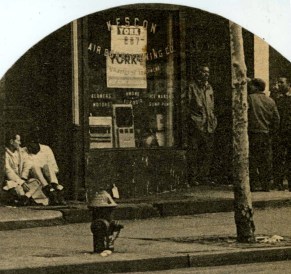
 

Years of leisure?

Years of leisure?

Let us now become less optimistic and, perhaps, more realistic. We cannot be at all sure that the transition from an industrial society to a cybernated world can be made without some major problems. A trip into the center of any large city will give a taste of the distasteful side of the process. Here we encounter huge numbers of the people who in any previous age would have sup­plied the backbone and the muscle of the economy. They are now shunted aside as the waste products of a society which no longer needs them but has found machines to do their work more efficiently and more cheaply.Unfortunately, those most likely to be replaced on the job by the machine are those who are least prepared to take advantage of their new freedom from toil. The less skill involved in the job, the more likelihood that a machine will take it over and the less likelihood that the worker displaced will have sufficient education to do something that a machine cannot do. The poor who inhabit the urban slums are only the first wave of those who will in the future be displaced by the machine. If our experience of the slum is any indication, very little is being done to create real opportunities for those being displaced by automation, such as opportunities for these persons to enter into human service.

What can be done to create such opportunities? Perhaps we can begin by questioning some of the conventional wisdom with which our society is plagued. We have already sketched the basis of classical economic theory, whose conventional solution to the problem of equitable distribution is the assumption that he who uses his energies to produce goods and services deserves to have his desires for goods and services met and that the non-productive must want. A more subtle convention has been woven into the moral fabric of society via the so-called “Protestant ethic” from its source in the Calvinistic doctrine of predestination.

According to that doctrine a man is either elected to eternal salvation or condemned to eternal damnation totally irrespective of his human merit. Being predestined before birth to either election or condemnation, one’s conduct of life can do nothing to alter one’s fate. However, a man can demonstrate to himself and to others that he is among the elect by the successful performance of his secular work or vocation. By combining with the exigencies of scarcity economics this ethic has produced the belief that a man’s productivity not only is the basis for human, social reward but may also be indicative of his worth in the eyes of God. Thus, society has evolved an almost unbreakable bond between a man’s ‘productivity on the job and his just share of the produce, his income.

While the job-income link may have made sense in the society of scarcity in which it evolved, it becomes impractical and unjust in a world of abundance where machines do the producing. Due to the advances of modern technology the traditional link between jobs and income is being broken. “The economy of abundance can sustain all citizens in comfort and economic security whether or not they engage in what is commonly reckoned as work. Wealth produced by machines rather than men is still wealth.” (Report of the Ad Hoc Committee on the Triple Revolution, Santa Barbara, March, 1964)

In the light of the changing economic realities, at least one concrete suggestion has been made which shows some promise of creating real oppor­tunities for those already or soon to be economically dispossessed by cybernation. Although revolutionary in its implications, it is a suggestion which has gained remarkable respectability since its initial statement three years ago. Sometimes referred to as the “guaranteed annual income,” it is the recommendation that “society, through its appropriate legal and governmental institutions, undertake an unqualified commitment to provide every individual and every family with an adequate income as a matter of right.” (Report of the Ad Hoc Committee on the Triple Revolution) The “guaranteed annual income” would make an adequate income the inalienable birthright of every citizen, along with life, liberty, a and the pursuit of happiness.

https://i0.wp.com/upload.wikimedia.org/wikipedia/commons/9/94/Sanzio_01.jpg

Everyman learning a living?

Were the right to income to be guaranteed, the potential freedom from want as well as the theoretical freedom from toil of which we have spoken would become actual for every citizen. Every man could afford the leisure, now largely used up in attempting to provide for himself materially, to truly seek the way best to fulfill himself as a human being. There are, it is true, those who hold that the guarantee of income would remove all incentive for people to do anything useful. The answer to this argument of course depends upon our understanding of what is “useful” and upon whether we are essentially optimistic or pessimistic about humanity. Can human beings really serve their own best interests and those of their fellows without external incentives to material acquisition? Put another way, can everyman “learn a living”? To these questions each must seek his own answer.

another Cliven Bundy?

Norman Sparks & arrowheads he collected

The Indians that made this stuff didn’t think it was anything special. They used it and tossed it aside. It was just used junk to them.

Here’s another story of a man whose family roots in a place predate today’s rules and who scoffs at “outsiders” who come to enforce the new rules:

http://www.latimes.com/local/great-reads/la-me-c1-relic-hunter-20140724-story.html#page=1

Mr. Sparks reminds me of a lot of men I knew in the Owens Valley and Death Valley areas. When I moved to Tecopa in 1974, I wrote about the impact a then proposed Wilderness designation would have on the mining tradition that, in part, led to designation of Death Valley as a National Monument:

“Death Valley Prospect: No Miners Allowed,” Coast, Aug. 1974.

I don’t think it’s just my Libra nature that sees these as more complex issues than they first appear. I’d be interested in your thoughts.

Another instance of a similar phenomenon occurred when thousands of Mormon pioneers persecuted in the East headed for what was Mexico when they left and became part of the US frontier shortly after the first of them arrived. They set down deep roots in Deseret and built a virtual empire around a religious principle, only to have new rules enforced upon them by a larger, outside power.


Hari Heath & Integrity

Betsy Russell has posted an update on Hari Heath, the author of “Integrity matters to Idaho Republicans, who stand firm,” a guest opinion in this morning’s Idaho Statesman (July 14, 2014).

It will be interesting to see how long it takes the Statesman to follow up with an “integrity” update about Mr. Heath? Of course, in some quarters his tax protests and anti-government beliefs will make him even more the hero.

Mr. Heath’s about as good at the integrity thing as Mr. Otter ($x billions lost to his privatized prison donors), Mr. Risch (effectively defunded public education in his brief performance as gov.), Mr. Luna ($16-million-&-counting loss of federal funds for schools’ digital network wrongly awarded to Otter cronies), Mr. Crane ($10-million–$24-million lost through mismanagement of public funds), Mr. Denney…. Need we go on…?

How I miss the likes of John Evans and Phil Batt; now’s there’s integrity, folks!

Progressives

I dropped by the Community Progressive celebration at Julia Davis Park on Saturday. My wife, Diane, was manning the booth of a new non-profit she’s helping that will enable seniors (like we have, inexplicably, become!) to stay in our homes as we age. Anyone whose parents did not prepare for their 90s can appreciate the need for such an organization.

I had an opportunity to make the rounds of the other booths. I was particularly struck by the presence of the labor unions, who had four booths. I was glad to see and chat those guys; a dozen or so were manning the booths and proudly presenting themselves as Progressives.

I don’t know if any studies have been done to show it, but I’ll bet there’s a direct corelation between implementation of the anti-union “right-to-work” laws and Idaho’s rise among states highest in percentage of minimum-wage earners.

Growing up back East in the mid-20th century, I took unions for granted. My family was part of the growing middle class whose children were leaving the mills and factories for commercial and semi-professional jobs. My own job history began on a truck farm, when I was 14—hoing through a muggy, hot Ohio summer for 50-cents an hour. I lied about my age the next summer and got hired as a prep-boy at a new Howard Johnson’s restaurant, where I quickly graduated to breakfast cook in the mornings, cashier and soda jerk in the afternoons. I was making 62.5 cents an hour, a 25 percent increase—No way was I going back to the farm!

The following summer my best friend’s dad got us jobs at a woolen mill on Cleveland’s west side, where he was controller. It was my first union job—United Textile Workers. I was making 72.5¢ an hour—a 45 percent hike over hoing. I was happy to return for a second summer before going off to Yale. In New Haven, during my sophomore and junior years, I worked at a corrugarted box factory and once again was a union member. That job carried me, my wife and our first-born umtil my scholarship was boosted to take over.

I’d venture to guess that the “right-to-work” laws have contributed heavily to the influx of undocumented low-wage workers into many jobs in the trades formerly filled by union members.

It was good to see both the union guys and Renee and Richard Stallings mingling among progressives on Saturday. Richard is running to regain his seat in congress held by Mike Simpson for too many years. I previously opined here about the punches Simpson pulled voting for, then, against the government shutdown last year. Stallings does not pull punches; he is as straight a shooter as I’ve known. He has spent his life in public service as a teacher, a local and federal official in several capacities and as a congressman from 1986–1992.

I worked with Richard to get the $900,000 appropriation from the Land & Water Conservation Fund (off-shore oil royalties) that made the complicated three-way land exchange work that saved Hulls Gulch from development. He knows how to make government work for people. Simpson has voted repeatedly to repeal Obamacare. He even voted to shut down the federal government for 16 days at a cost of some $24 billion in a cynical attempt to cripple the health-care law.

…but I ramble….

It’s good to see Democrats and union guys identify as Progressives. Isn’t that kinda like . . . liberal?

It’s official: I’m a Democrat

Here’s how it happened:

I thought I was accompanyng my wife, Diane Ronayne, to the Idaho State Democratic convention this past weekend in Moscow, where she was an Ada County and Second Congressional District delegate. When she came back from registering Friday morning, she handed me a name tag and a folder and announced that I, too, was a delegate. I’m not sure who actually made me a delegate, but I decided not to make a scene and go along for the ride.

Several times in Idaho I have been called a communist in public. Now, it’s official; I’m a Democrat. I actually helped get the term “climate change” in the party platform, which some, no doubt, will see as evidence for the veracity of those former allegations. In some quarters, regulating the private exploitation of natural resources, land-use planning and public schools are communistic ideas—which, of course, they are—communal efforts to address the common good. Recognizing human caused global warming is perceived in those quarters as a United Nations Agenda 21 plot for world domination.

At Friday morning’s hearing on the first draft of the Democratic platform, a delegate recommended including “action against carbon-induced global warming” in the natural resources stewardship plank. It was one among a couple dozen suggestions from delegate members. At the Saturday morning hearing on the second platform draft, I was among several delegates who rose to speak.

I complimented the platform committee chair for the artful job her group did in incorporating most of the suggestions made the previous day, but called her attention to awkward phrasing of the sentence inserted to address global warming: “For the sake of future generations, we are committed to taking proactive measures to prevent and mitigate climate disruption.”

“I know we’re trying to avoid the term ‘climate change,'” I said. “However, climate cannot be ‘disrupted.’ Climate is the average pattern of meteorological variables such as temperature, humidity, wind, precipitation, etc.” I suggested that the phrase “the harmful effects of climate change” be substituted for “climate disruption.”

“The deniers are not going to be voting for us anyway,” I concluded. When the final draft was adopted unanimously Saturday afternoon, it contained the recommended amendment, minus the word “harmful.”

As has been widely reported, the convention was a love fest—quite a contrast from the Republican convention the week before, which failed to adopt a platform or elect a party chairman. Since they did not adopt a platform, the Republicans are stuck with a 35-page relic that emraces such Tea Party idiocy as repeal of the 17th amendment, which removed election of US Senators from state legislatures and gave it to the people.

The new Idaho Democratic platform is a one-sheet, two-page document that expresses the values Democrats share. It does not get embroiled in the policiy debates about how we act on those values. That theme—spelling out Democratic values and acting on them—was echoed in a rousing keynote address by Ed Rendell, former district attorney and mayor of Philadelphia, and attorney general and two-term governor of Pennsylvania (2003-2011).

Gov. Rendell emphasized the risks that acting on those values sometime requires. He illustrated be reviewing his daring first-term success raising Pennsylvania’s $5.15 minimum wage by 40 percent—to $7.15 in one year!

…which brings me to a trip several Idaho Democrats are making around the state today, June 24:

Foprmer 2nd District Congressman Richards Stallings, who is campaigning to regain his seat from Mike Simpson, is joining Lt. Gov. candidate Bert Marley and US Senate candidate Nels Mitchell
in a series of news conferences across southern Idaho. They terminate their trip on the Statehouse steps at about 4:15 p.m. They are proposing raising the minimum wage from $7.25 to $10.10.

Former US Rep. Stallings called to say he’d like folks to show up in support of the minimum-wage announcement. (see letter below)

He also agreed to come to Boise—tentatively Friday, Sept. 5—to meet with some friends at my home—especially those who helped save Hulls Gulch. (Directions & more info to follow for those who express interest.)

A couple decades back, Rep. Stallings played an important role in sealing the deal that saved Boise’s Hulls Gulch from development  He got us $900,000 of Land and Water Conservation Funds to make the complicated three-way land swap work.

Richard would bring real integrity back to our 2nd District representation in Congress; that’s why I’m supporting him.

Please, take the time to read his letter and/or visit his website; I think you’ll agree with him. He doesn’t pull punches (like voting to shut down the government in a cynical attempt to cripple Obamacare, then 16 days later, when INL workers are about to be furloughed, voting to end it).

Stallings for Idaho

Friend,

There is a crisis in Idaho. This is a crisis that is not caused by nature or terrorists, but by insensitive and mean spirited elected officials. This crisis is getting little or no press coverage and this crisis has NO ONE who is drawing the public’s attention to it–until now!!

Tomorrow, June 24, the Stallings for Idaho campaign, accompanied by Nels Mitchell, our Senate candidate, and Bert Marley, candidate for Lt. Governor will hold a series of press conferences across the 2nd CD to draw attention to this crisis by launching the R.T.M.W (Raise The Minimum Wage) crusade.

The current $7.25 minimum wage has forced tens of thousands of minimum wage workers to survive in poverty. According to the state, we have 29,000 Idahoans working at minimum wage and another 140,000 whose day to day lives would be drastically improved if Congress raised the minimum wage to $10.10. This simple act would add $5400 annually to those making $7.25 an hour and benefit at least 176,000 Idahoans. It would reduce the cost for federal food stamps, and benefit every community because these hard working folks would spend their additional funds locally. Families would have more time for their kids and, perhaps, allow them the opportunity to put extra dollars towards better job preparation and education. I believe this simple act would go a long way to restore the American dream for thousands of our fellow Idahoans.

I need your help! In fact I need the help of every Progressive, Democrat, Independent, and concerned Republican to help end this crisis. We need volunteers to assist with the voter registration effort and we need funds to hire some of these minimum wage folks to engage their friends and the public.

The Stallings for Idaho campaign has recently hired two single moms to help us find and register minimum wage workers to vote and, when we raise the necessary funds, we will hire more. We would like RTMW workers in every community as our goal is to register 5,000 new voters in the 2nd Congressional District.

A $10 contribution will hire a single mom, or a college student for one hour. A $100 contribution will put someone to work for ten hours. Please help, as your gift will be used exclusively to assist with our RTMW campaign, and 5,000 new single issue voters will help progressive candidates throughout Idaho. If you can volunteer please email us at rtmwcampaign@gmail.com.

https://democracy.com/Richard-Stallings/

Sincerely, Idaho’s Congressman
Richard Stallings
P.O. Box 154
Pocatello, ID 83204