 Can you identify this mysterious yellow blob that I photographed at a little park near the overlook for Snoqualmie Falls in Washington? It was lying in a grassy area strewn with pine needles after a misty rainfall; it’s about 2″ to 3″ in diameter. I would guess it is a fungus that grew out of the damp ground; or, perhaps, it fell there from one of the pines….
Photos
digital images
New photos from our Boise “backyard”
A few hundred yards from our home in the Boise foothills:

Overlooking Cottonwood Canyon, Fort Boise Military Reserve, Boise Foothills 2014 © GaryERichardson
Sand and gravel used in construction of Fort Boise was taken from the hillside above the road to the gold mines near Idaho City, the largest town in the Northwest in the late 19th century. The road passed through the fort to ensure that gold from the mines made its way to the Union treasury.
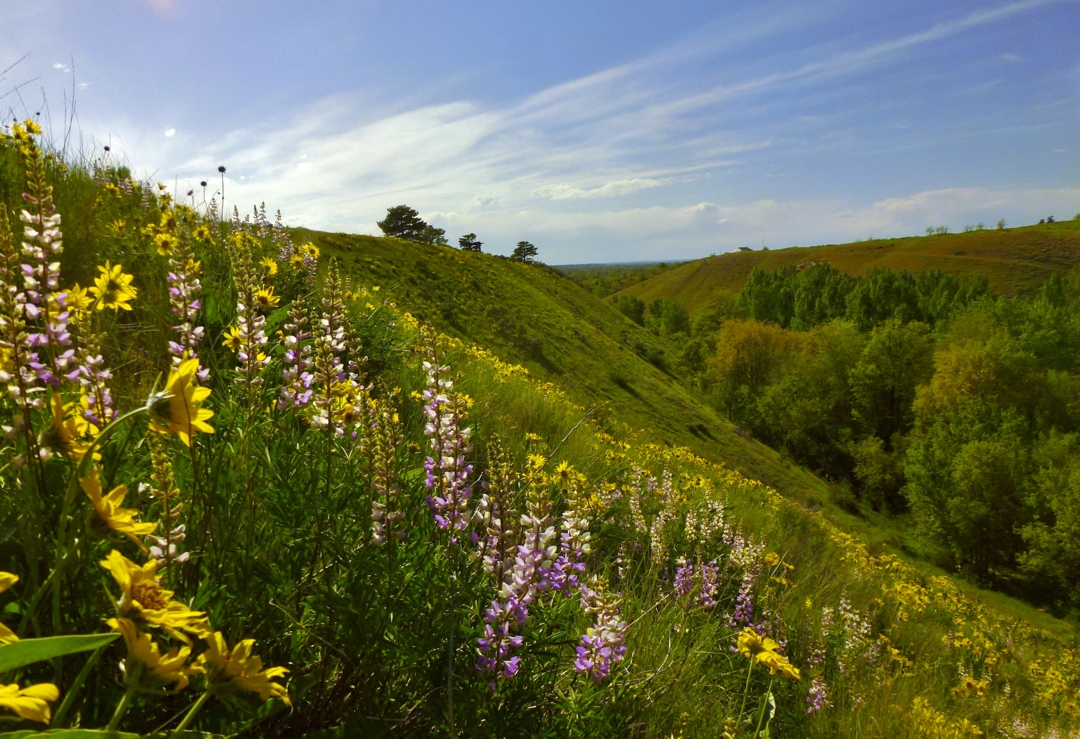
Lupin & Arrowleaf Balsam 2014 © GaryERichardson
At times like this, one almost forgets that we live in the high desert.

Phlox, balsam & sage 2014 © GaryERichardson

Bitterbrush, sage, balsam 2014 © GaryERichardson
Boise Balsam
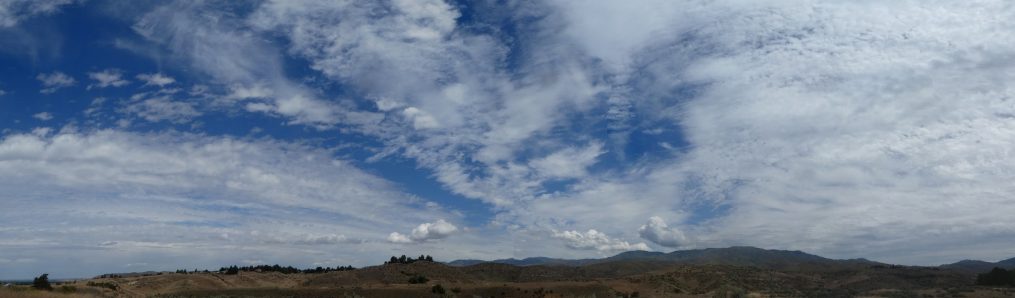
I’ve wanted to properly display a panorama of the Boise skyline that I created a few days ago with a series of digital images I made from a field of yellow arrow-leaf balsam flowers in the Fort Boise Military Reserve overlooking downtown.
Here’s my latest attempt:

This is a Google+ link to the panorama that I previously posted on Facebook, where there is no way to enlarge the image and pan the skyline.
Once you establish the link, above the image click on the little magnifying glass icon with the “+” sign. A box appears to the upper left that enables enlarging and panning the image from the M-K Plaza building on the left to the 6th & Fort, Jim McClure Federal Building on the right.
Thanks to Mike Rolig at Google, who turned me on to this capability of Google+.
I’ll be looking for a way properly to display panoramas here. If you’ve had success doing that with Word Press, please tell me how.
Paul Gaylord Crockett 1924–2014

Paul Gaylord Crockett
Feb. 24, 1924–Jan. 10, 2014
I have received word from his wife and partner of 40 years, Sylvee, that Paul Crockett, “an amazing, incredibly wise man, took his departure on Jan. 10, 2014.
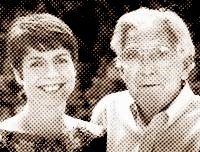
Sylvee & Paul Crockett
“He held up so much for so many that I hope the Earth does not crack,” Sylvee wrote. “Not always kind in the way I wanted, he was ever my friend, always in support and wanting the best for me.
“Such a beloved, Dear Paul, 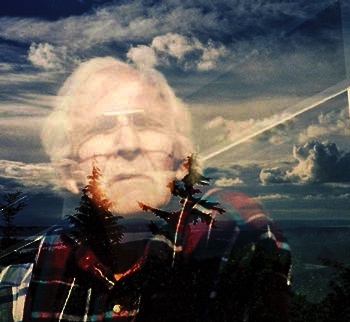
“May your flight be easy, your arrival heralded and your travels ever filling your heart with love….”
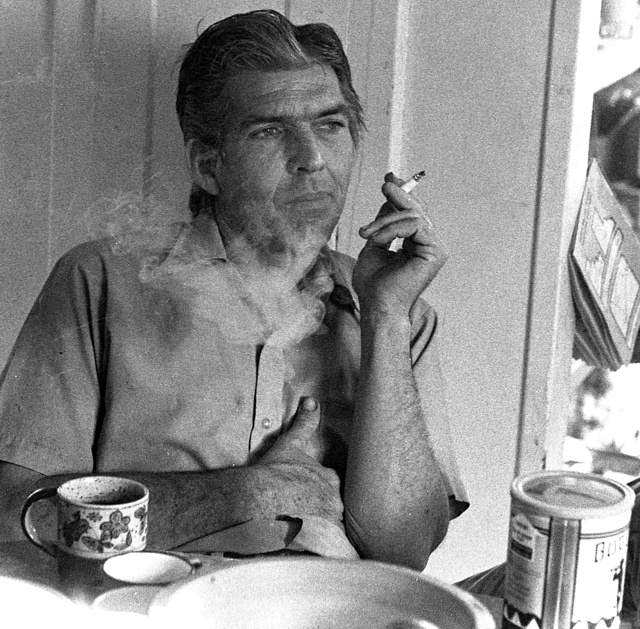
I first met Paul Crockett in 1972. He was taking the gate as manager of Desert Sun at a dance-concert in Lone Pine, a small desert town below Mount Whitney in eastern California. I had heard the group perform a week earlier at a movie theater in Bishop, where they had opened for another group. Desert Sun’s self-styled “conscious music” received a none-too-favorable reception by a crowd high on reds, whites, and booze.
The Lone Pine concert was held in the dark and dingy town hall, the size of a basketball court, with a stage at one end. The musicians were more at home in the smaller venue, where they could almost touch the few dozens of people who showed up to dance and listen. I was in my early 30s, going through some heavy personal changes. The men on stage were ten years younger than I, yet their music communicated an almost mystical acquaintance with personal struggles to find oneself. They played one song a couple of times that night that particularly resonated with me:
Look around. Where are you?
Look around. What ya goin' through?
Is it real or only what you feel?
Look around. Where are you?
Are you trapped by your philosophy?
Has what you learned really set you free?
Look around. Don't worry.
You got the rest of infinity.
Where are you?
I wanted to know more about these guys and what they had been going through. During one of the breaks I approached the flutist and apparent leader of the group and asked if they’d like to go out in the hills with us after the concert and get stoned.
“This is how we get high,” he replied, off-handedly, without judgment.
“Far out!” I said, rolling with it. “Well, come along anyway and get high off the rocks. Have you ever been to the Alabama Hills?” He indicated that he hadn’t.
“They’re these unbelievable rock formations just a few miles out of town,” I continued. “There’s a full moon tonight and it’s like being on another planet out there. We live on an old mining claim; and if you don’t have to get back to Shoshone tonight, you could stay with us there.”
I felt an immediate rapport and wanted to get to know him better. He seemed interested but said he didn’t know what their plans were yet. He’d let us know after the concert. As the music resumed I was swept back to the dance floor.
When the concert ended and the lights came up, I grabbed a broom to help clean up. The fellow who had been collecting the gate was also sweeping. As we disposed of a small pile of rubbish we had swept to the center of the room, he introduced himself as Paul Crockett, the group’s manager. Leaning on our brooms we engaged in a bit of small talk in the course of which he mentioned that he had been prospecting around the Southwest for a few years. I asked where.
He mentioned places in New Mexico, Arizona, Nevada, and Goler Canyon in the nearby Panamints, the range of mountains forming the western boundary of Death Valley. His familiarity with Goler Canyon immediately sparked my interest. It was there that Charles Manson and his Family had been arrested a few years earlier. Not only had Crockett been there around the time of Manson; he had spent some time with him. I was bursting with curiosity.
“You see those two fellows up there?” Crockett continued, pointing to Paul Watkins, the flutist, and Brooks Boston, the lead guitarist, who were packing up equipment on stage. “They were with Charlie.”
“You mean they were in the Family?” I asked.
“For more than a year,” Crockett said.
I told him about my interest in what actually went on in the Manson Family and asked if he would do an interview about his experiences with Manson. He agreed and suggested that I would also be able to interview Brooks and Paul about their experiences since the court order silencing them had recently been lifted following Manson’s conviction for the Tate-LaBianca murders.
With the hall cleaned and the group’s equipment packed, we moved our discussion to the Sportsman Cafe. Over coffee I arranged to visit them in Shoshone a week later when they would give me as much time as necessary. Paul Watkins did accompany us to the Alabama Hills that night, but I decided to deferred discussion of his association with Manson and contented myself with small talk and listening to him play the flute.
My stay in Shoshone lasted ten days. I had arrived hoping to gain some insight into the internal structure of the Manson Family, perhaps enough material for an article. I was particularly interested in Manson’s methods of “programming” his followers, a subject about which little of substance had been written. I got much more than I bargained for.
I found in Paul Crockett a homespun guru. His knowledge of the way realities are structured by agreements enabled him to understand what Manson was up to. Crockett’s insight enabled him to show several members of the Family how to break from Manson.
Following those ten days of interviews at Shoshone, a few months later I moved to Tecopa, a town a few miles south of Shoshone where Crockett and Desert Sun had relocated. I spent the better part of the next two years with the group.
For my profile of Paul Crockett published in Psychic (later, New Realities) magazine in 1975, go to:
https://garyerichardson.com/wp-content/uploads/2013/06/crockett-profile001.pdf

Paul Gaylord Crockett
2/24/1924–1/10/2014
Cabinet meeting
New York Times photographer Doug Mills shot an overhead view of the president meeting with his cabinet—sans Secretary Kerry who is in Geneva negotiating international takeover of Syria’s chemical arsenal with the Russian foreign minister. I note that the president is flanked on his side of the table by four women and two men; I wonder if such an alignment occurred in previous administrations:
President Obama meets with his Cabinet… missing is Secretary Kerry. #Syria pic.twitter.com/gGEPcA37pN
— Doug Mills (@dougmillsnyt) September 12, 2013
Photo (metaphor?) of the day

Jonathan, who removed Sravasti Abbey’s wasp nests, amuses the abbess.
Yesterday morning, I received my monthly eNews from Sravasti Abbey, which is celebrating its 10th anniversary this month. Among the many colorful photos illustrating the monastery’s remarkable decade of progress, the one above caught my eye.
Ven. Thubten Chodron and her two cats, shared our Boise home for several months during her search for an abbey site. She had been encouraged to establish a US abbey for training nuns in the lineage of the Dalai Lama, who ordained her 30 years ago. Because of her close association with Treasure Valley Dharma Friends, she first hoped to locate the abbey in southwestern Idaho. As it turned out, a beautiful site became available north of Spokane, near Newport, WA, just over the state line from Old Town, Idaho.
While most of my Buddhist practice has been in the Vietnamese Zen tradition of Thich Nhat Hanh, we’ve had the pleasure over the years to host several Tibetan monks in addition to Chodron. Several years ago, we hosted Khensur Rinpoche and his translator, in Boise to give Dharma talks on his way to bless the Washington land Chodron had found for the abbey. Tulku Damsho Rinpoche and his attendant, Lama Sonam, stayed with us this past week while in Boise to give a commentary on Gampopa’s “Jewel Ornament of Liberation.”
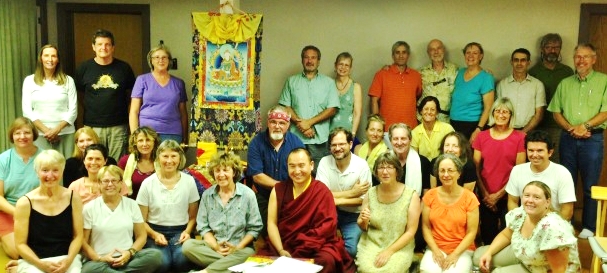
Tulku Damcho Rinpoche and Dharma Friends
For a couple evenings, I listened with about 30 Treasure Valley Dharma Friends as the Tulku recited his commentary in Tibetan, referring occasionally to his notes on the iPad in front of him. He would speak for a minute or two, then pause for translation and commentary by Jules Levenson, a professor from Naropa, the Buddhist university in Boulder, Colorado.
Gampopa was a student of Milarepa, the 12th-century CE Tibetan yogi and Buddhist lama. Tulku Damcho is said to be the reincarnation of Lama Tsokni, who led thousands of austere, fasting retreats in Tibet dedicated to the Thousand-Armed Bodhisattva of Great Compassion, before the Chinese invasion. Reincarnation has not been an important tenet in my personal understanding of the Buddha’s teachings. Those teaching were not written down until several hundred years after Buddha’s death, but they are passed on in practice and orally from teacher to student in an unbroken line from students of the Buddha down to the present. Listening to Prof. Levenson translate Damcho’s commentary on the 12th-century “Jewel Ornament,” itself elucidating the then-1600-year-old teachings of the Buddha, I was witnessing the reincarnation of ancient thought.
John Rember’s persistent warnings to his writing students of the dangers of metaphor came to mind: “Metaphors damage your ability just to witness the world.” I think that’s what the 8th-century Zen monk Lin Chi (AKA Linji, Lam Te, Rinzai) was getting at when he wrote:
Followers of the Way,
Buddha is not to be attained.
There is no real Dharma;
it is all but surface manifestations,
like printed letters on a sign board to indicate the Way.
I slipped a copy of this iconoclastic Zen metaphor to the Tulku as he left for Shambhala meditation center in Colorado.
Matters of perspective

July 19, 2013: the wide-angle camera on NASA’s Cassini spacecraft captured Saturn’s rings and planet Earth and its moon in the same frame. Nearly 900 million miles away in this image, Earth appears as a blue dot at lower right; the moon is off its right side. (The two are seen as separate objects in an accompanying composite image PIA14949.) Other bright dots nearby are stars.

Aug. 10, 2013: Smoke from a fire in the Smoky Mountains to the west rises over the Wood River Valley.

Aug. 10, 2013: Smoke from the fire that a few days later threatened the Wood River resort communities, rises over the Sun Valley Summer Symphony’s tribute to James Bond.
On Friday, Aug. 16, we were evacuated from our camp site on the North Fork of the Big Wood River, as the fire crept down northeastward drainages:
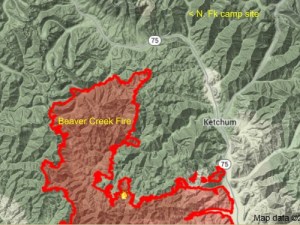
So, we headed north, over Galina Pass and into the Sawtooth Valley.

There, our friends Donna Marie and Bob Hayes let us camp in their “front yard.”

Fisher Creek runs through it. Click through to hear and see it on its way from the White Clouds to the Salmon, August, 2013.
Update from Paradise (or damn near)
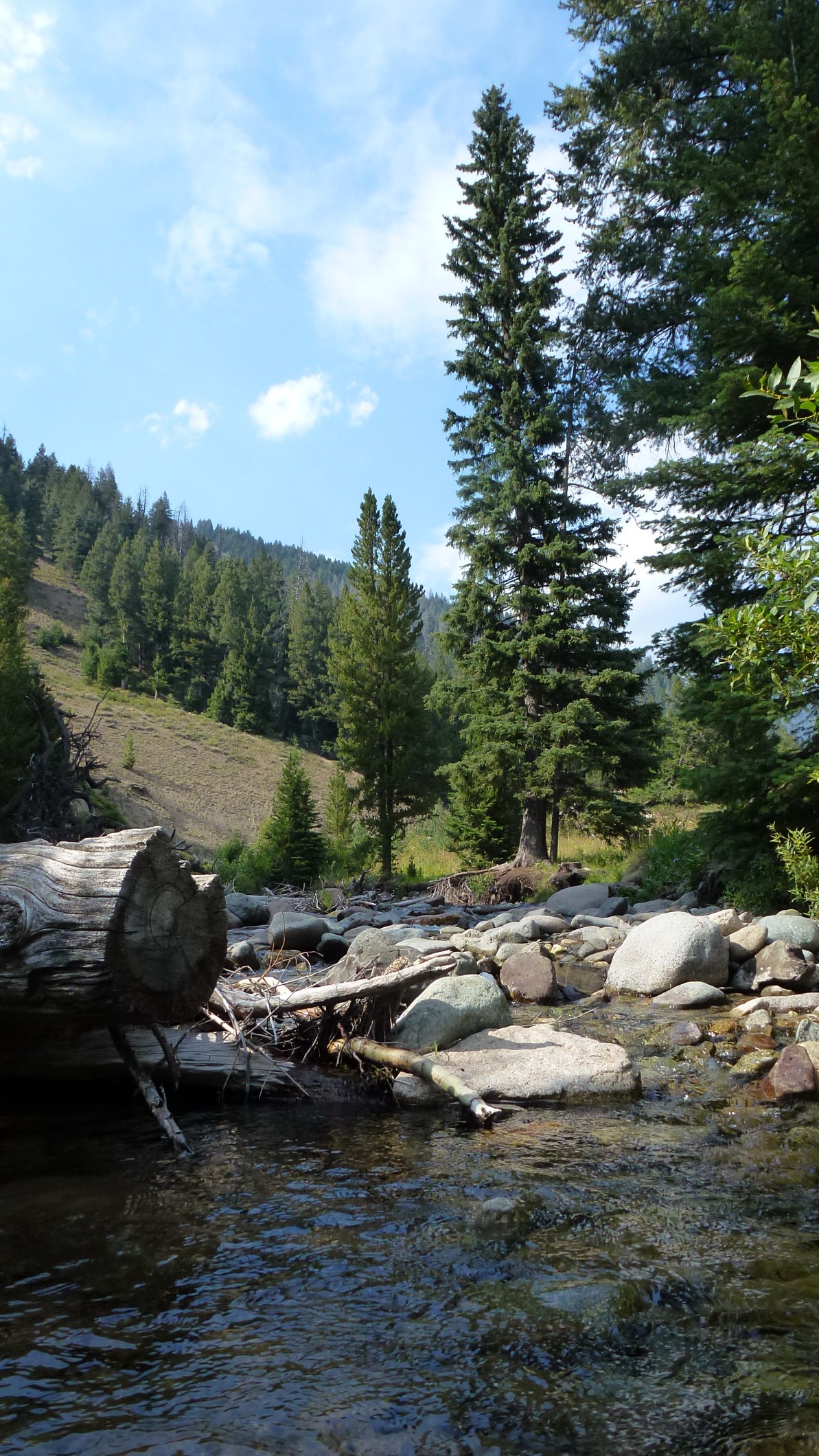
Words of Wisdom…

above Deer Park
…from a Zen brother:
There is this deep understanding that everything is always perfect simply because it is. It is not an understanding of the mind or logic, it is rooted completely in the heart. Although, like all of us, much spiritual practice, reading, meditation and retreats have occurred, this lesson comes directly from life:
Enough times seeing that what I thought was horrible and totally unacceptable turned out to strangely be exactly what was needed for the very best results.
Enough times learning that devastating pain seemed to be the most brilliant spiritual teacher of all.
Enough times seeing that those who I most feared or resisted were all actually just me in different clothes and coming to this seemingly other me with the exact perfect lesson.
Enough times to turn all my thoughts and beliefs and ideas completely upside down, until I finally saw that they were all, all of them, total illusion, blindness and ignorance.
It doesn’t mean I don’t live my life in service to others and work for the benefit of all. But I also know that I don’t know what that means.
It doesn’t mean deep grief and sadness and even occasionally a little anger don’t arise when I forget how perfect this seemingly crazy world is and always has been.
There are no others. There never has been a hair’s breadth of separation anywhere, ever. And yet … and yet this illusion appears so very real. It’s not surprising that it fools us so completely. The best solution may be to rest in this silence that has no answers, no questions, no ideas or beliefs. To help others knowing full well there is no other we are helping. We are only helping our self in the amazingly varied costumes we appear in, just as we are being helped in return. It’s not something the mind can really comprehend, but it is the best help we can offer. This is helping in truth.
Much Love and Many Bows to you, as myself in all its amazing variety and diversity, from warlords, corporate chiefs, politicians, trees, mountains and insects to the many gentle spiritual Bodhisattvas (including my wonderful cat Zen) who through their love help to shatter the illusion that is solely responsible for all human suffering.
—Peter Cutler
Wildflowers: Fort Boise Military Reserve
I took a walk in our 400 acre backyard this morning.

Flea bane

Anyone know what these are called?

Buckwheat

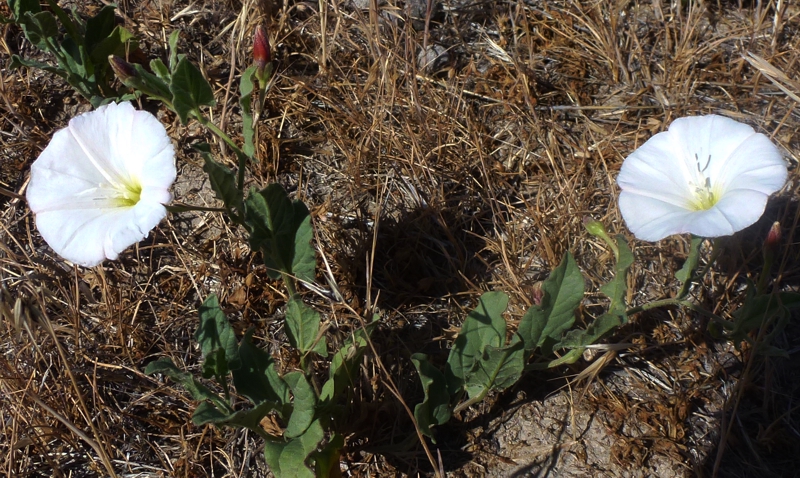
Bindweed/wild morning glory

Wild onion

Desert evening primrose

Yarrow, Bachelor’s button
 Richardson's rummage
You must be logged in to post a comment.